
Recruitment challenges in manufacturing SMEs in Nepal go far beyond attracting applications. The real struggle lies in finding the right people, workers who join, show up consistently, learn fast, follow safety practices, and stay long enough to stabilize production.
When hiring is weak, the costs are silent but real output drops, defect rates rise, supervisors spend more time firefighting than managing, overtime becomes routine, and delivery deadlines slip. These workforce challenges are a daily reality for Nepalese SMEs, requiring solutions tailored to the factory floor rather than generic HR advice.
The Biggest Recruitment Challenges in Manufacturing SMEs in Nepal
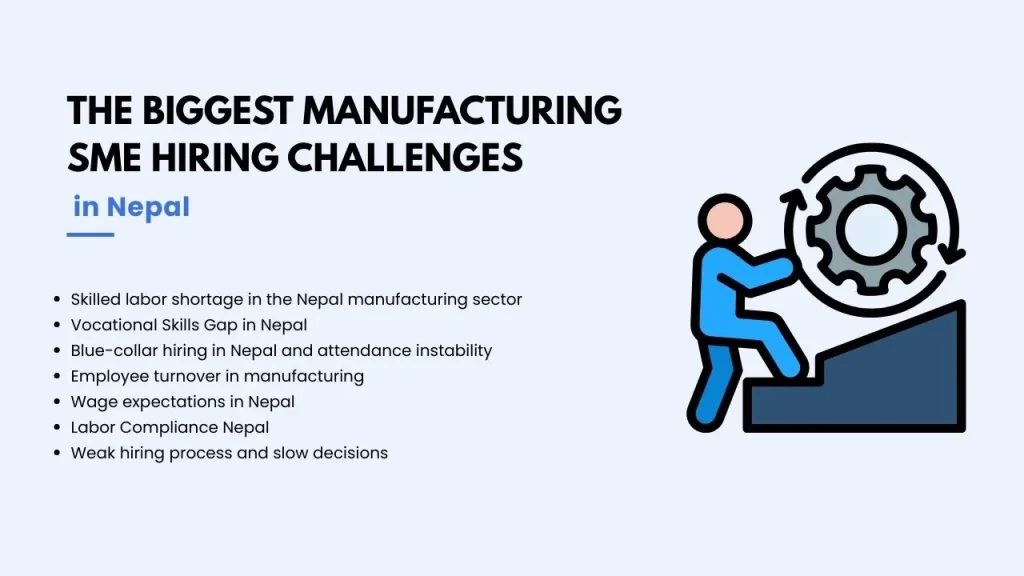
Skilled Labor Shortage
Addressing recruitment challenges in manufacturing SMEs Nepal requires practical hiring methods, including trade tests and structured onboarding. Machine operators, maintenance technicians, welders, electricians, quality control staff, and capable line supervisors are limited in Nepal. Larger firms often attract these workers with higher pay, better benefits, and job stability, leaving SMEs struggling to secure reliable staff.
Without dependable core talent, scaling production is difficult, and SMEs face constant risks of poaching and turnover. When skilled roles are hard to fill locally, SMEs can work with a Recruitment Partner or Staffing Service to ensure faster hiring and higher reliability.
Vocational Skills Gap in Nepal
There is often a mismatch between what candidates claim on paper and what they can do on the shop floor. Many manufacturing roles require hands-on skills, discipline, safe work habits, and consistent output. Certificates and degrees alone rarely guarantee job readiness.
SMEs must invest additional time in training and supervision, which slows ramp-up times and increases operational strain.
Attendance and Reliability Issues
High absenteeism and early quits are common among blue-collar workers in Nepal. Even if SMEs continue hiring, workforce stability suffers if joining rates are low or retention in the first 30–90 days is poor.
A missing worker on a production line can halt operations. In manufacturing, reliability is just as critical as headcount. Tools and HR analytics can help track attendance and predict workforce stability.
Employee Turnover
Turnover hits SMEs harder than larger firms. Lean teams mean that when one person leaves, others must cover shifts, increasing overtime, fatigue, and errors. This creates a vicious cycle, leading to even higher attrition.
Retention is improved by predictable schedules, transparent career paths, and supervisors who can effectively manage people, not just machines. Learn more strategies in How Nepali companies can reduce employee turnover in 2026
Rising Wage Expectations
Workers in Nepal frequently compare wages and switch jobs for small increases if they perceive no growth. SMEs often negotiate case by case, which creates internal inequality and fuels churn.
A structured wage ladder linked to skill, reliability, and attendance is far more effective than ad hoc increases.
Labor Compliance Pressure
Manufacturing requires strict compliance due to shift work, overtime, safety regulations, and documentation. Inconsistent contracts, unclear overtime rules, and poor record-keeping can lead to disputes and reduce trust.
Manufacturing requires strict compliance due to shift work, overtime, safety regulations, and documentation. Inconsistent contracts, unclear overtime rules, and poor record-keeping can lead to disputes and reduce trust. For detailed guidance on labor laws, SMEs can refer to the Nepal Labour Act 2074
Weak hiring process and slow decisions
Many SMEs operate with unstructured, slow hiring processes: unclear job descriptions, inconsistent screening, and delayed decision-making.
In manufacturing, speed and structure must go hand in hand. Slow processes lose strong candidates, while fast, unstructured hiring leads to poor-quality hires.
What manufacturing SMEs should do differently
Manufacturing hiring requires proof, not promises. Practical tests, clear joining plans, and strong early onboarding are more effective than relying on interviews or verbal offers.
A simple hiring system that works for factories
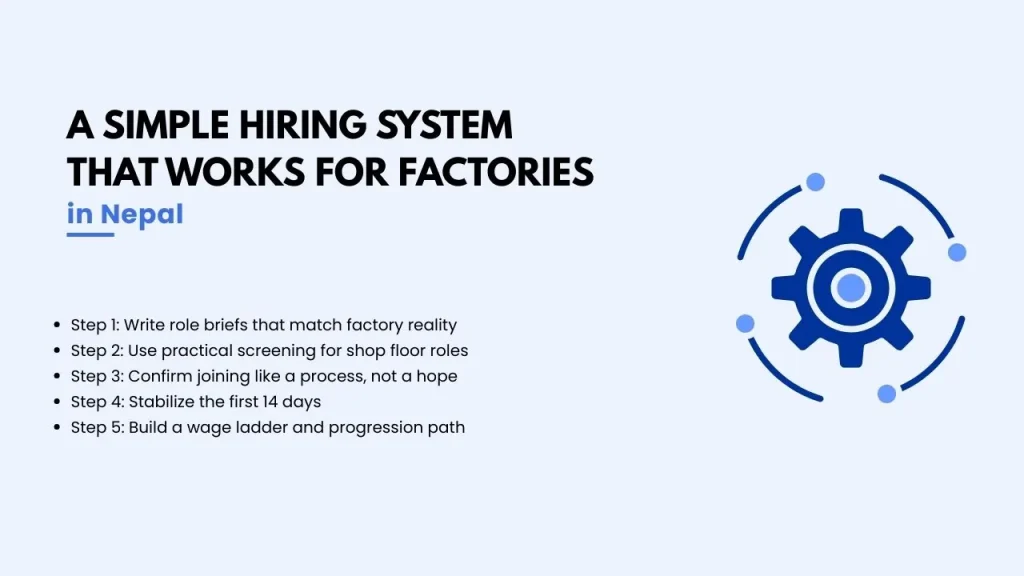
Step 1: Define Roles Clearly for Factory Workers in Nepal
Role briefs should include shift timings, location, physical demands, safety requirements, expected output, reporting lines, and what success looks like in the first 30 days.
Clear role briefs reduce confusion, improve joining rates, and minimize early quitting.
Step 2: Use Practical Trade Tests to Close Skills Gaps
For manufacturing roles, practical trade tests (30–45 minutes) are more effective than interviews alone.
Testing skills early reduces wrong hires and improves workforce reliability.
Step 3: Manage Joining as a Structured Process
Confirm start dates, documents, transport plans, and first-day supervision. Treat joining as a structured operational step rather than a hope.
This prevents gaps between offer acceptance and actual attendance.
Step 4: Stabilize the First 14 Days for New Employees
Early weeks define long-term retention. Induction training, safety orientation, buddy systems, and daily supervisor check-ins help workers settle and perform consistently.
Tracking attendance immediately reduces early attrition dramatically.
Step 5: Build a Transparent Wage Ladder and Growth Path
Transparent levels tied to skill and reliability improve retention. Link increments to measurable outcomes such as attendance, output consistency, defect rates, and tenure.
This addresses wage expectations without escalating costs randomly.
A 30-day action plan for manufacturing SMEs
Week 1: Finalize role briefs, assign decision owners, standardize interviews & trade tests
Week 2: Start sourcing candidates (referrals, walk-ins, local networks) and practical tests
Week 3: Standardize onboarding, safety induction, supervisor routines, track early no-shows
Week 4: Launch wage ladder, attendance incentives, review early attrition
What to Track Workforce Stability
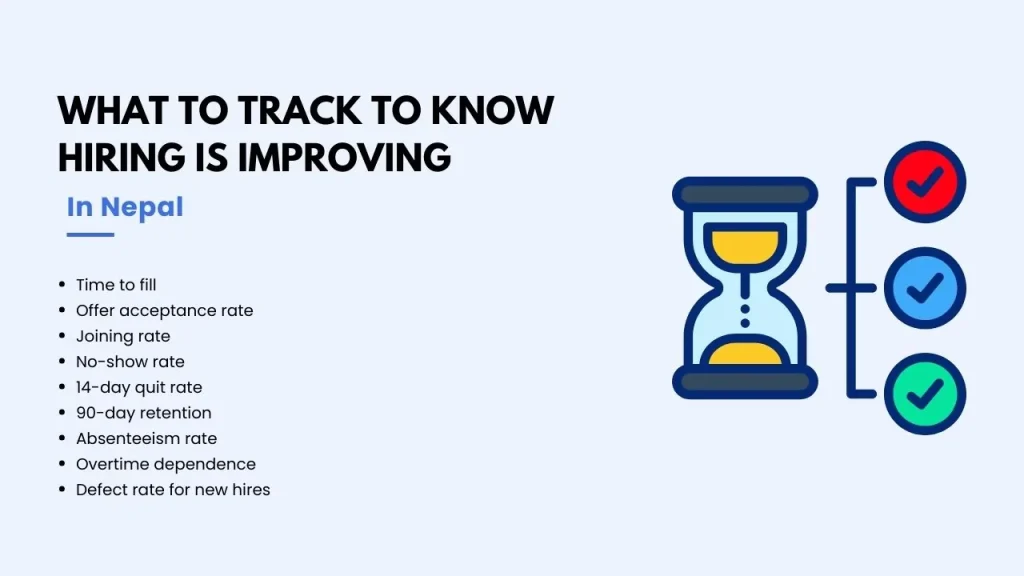
Track outcomes that show stability, not just activity.
- Time to fill
- Offer acceptance rate
- Joining rate
- No-show rate
- 14-day quit rate
- 90-day retention
- Absenteeism rate
- Overtime dependence
- Defect rate for new hires
If these improve, your industrial workforce in Nepal becomes more predictable, and production becomes easier to plan.
When to use a recruitment partner
Use a partner when:
- Skilled roles are in a small local pool
- Early attrition is high
- Screening or practical evaluation is weak
Demand practical testing, scored shortlists, fast turnaround, and clear replacement guarantees. Otherwise, CVs alone will not solve workforce challenges.
By understanding the recruitment challenges in manufacturing SMEs Nepal, SMEs can design better hiring systems, reduce turnover, and stabilize production.
FAQ
What are the biggest recruitment challenges for manufacturing SMEs in Nepal?
Skilled labour shortage, vocational skills gap, attendance instability, high turnover, rising wage expectations, compliance pressure, and slow hiring decisions.
Why do manufacturing SMEs struggle to hire in Nepal?
They operate with lean teams, compete with larger employers, and often hire for roles where reliability and hands-on skill matter more than resumes.
How can SMEs improve hiring factory workers in Nepal?
Use role briefs that match shift reality, add practical trade tests, manage joining tightly, and stabilize the first 14 days with structured onboarding.
What is the quickest fix for the vocational skills gap in Nepal?
Stop relying on certificates and interviews alone. Use practical tests and trial shifts, then train with a clear skill ladder inside the factory.
How do you reduce employee turnover in manufacturing?
Predictable schedules, fair wage progression, strong supervisor routines, and tight early onboarding reduce churn more than constant sourcing does.