Finding the right person for a job is more than just filling a position. By following a structured recruitment process in Nepal, your business gains three key advantages: better hires, smoother compliance, and reduced turnover.
Hiring too quickly without clarity can lead to mismatches. Three months in, the employee might not fit the role, costing you both time and money. A clear process helps you avoid these issues.
To avoid such mismatches, see our detailed breakdown Recruitment Mistakes in Nepal: How Companies Can Improve Their Hiring Process.
In Nepal’s legal environment, following proper recruitment steps also protects your business from risks such as fines, labor disputes, or contract issues.

Why follow a step-by-step recruitment process?
Because each step builds on the previous one, planning leads to sourcing, which leads to selection, which leads to onboarding. Without sequencing, you might skip key checks and end up with poor outcomes.
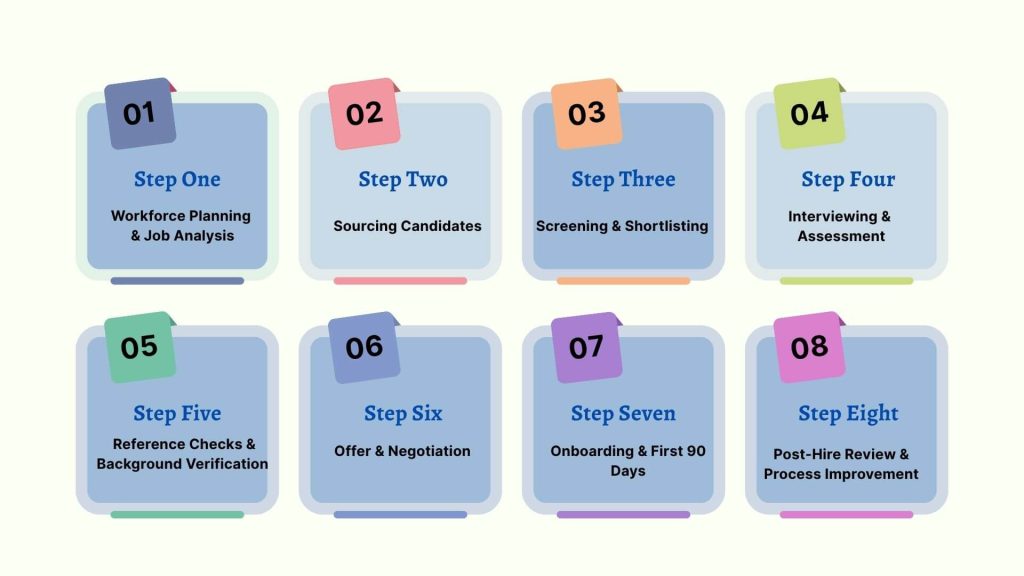
Steps for a Structured Recruitment Process in Nepal
Here is a step-by-step checklist to hire the right talent for your job role:
Step 1 – Workforce Planning & Job Analysis
- Clarify hiring needs before posting a job,
Understand exactly what your business requires. - Outline the role, performance metrics, and budget,
Know the outcomes you expect and how you’ll track success. - Write a concise job and candidate profile,
Include position title, key responsibilities, essential skills, and bonus qualifications. - Ensure the hire supports business goals,
Every new employee should contribute toward objectives like increasing sales or improving customer experience.
Why does this matter, & What should a job description include?
When you rush into advertising without planning, you get many unqualified applicants and waste time. Workforce planning Nepal helps you target the right people from the start. You should include details like job title, key responsibilities, required experience, salary band (if possible), probation period, and who the person reports to.
Step 2 – Sourcing Candidates
Once the role is defined, you’ll start finding the right candidates. You have different channel options for the recruitment process in Nepal:
- Job boards: MeroJob, JobsNepal (wide reach, may include unqualified applicants)
- Social media: LinkedIn, Facebook groups (good for younger talent, requires vetting)
- Referrals: Often faster and higher quality
- Headhunting: Ideal for niche or senior roles
- Recruitment agencies: Expertise and time-saving, though costlier
For general roles, combine job boards and referrals. For senior or niche roles, agencies or headhunting are effective.
| Method | Best For | Pros | Cons |
| Job boards | General roles | Large reach | Many unqualified |
| Referrals | Mid-level | High quality | Limited scale |
| Skilled roles | Targeted | Time-consuming | |
| Agencies | Senior/technical | Fast + high quality | Fee involved |
Which sourcing method works best in Nepal?
For general roles, job boards + referrals work well. For niche or senior positions, a recruitment agency Nepal or a headhunting approach might pay off faster.
For companies that rely heavily on LinkedIn sourcing, see How to Use LinkedIn Effectively for Recruitment in Nepal.
Step 3 – Screening & Shortlisting
Filter applications effectively to focus on the best candidates.
Checklist:
- Track candidates via an ATS or a simple spreadsheet
- Match candidates against education, experience, and skills requirements
- Conduct pre-screen phone/video calls
- Use skill tests for technical roles
Note: Use the ‘must-haves’ criteria from the job description to eliminate unqualified candidates and prioritize the best recruitment practices for Nepalese employers.
How to shortlist efficiently without losing quality?
Use the “must-haves” criteria you defined in the job explanation. Eliminate those who don’t meet them. Then prioritize higher-fit candidates for deeper assessment.
To improve your shortlisting accuracy, follow the techniques in How AI is Changing the Recruitment Process in Nepal.
Step 4 – Interviewing & Assessment
The interview stage is where you separate the “potential” from the “fit.” A structured approach is key.
How to approach the interview process in Nepal:
- Structured interviews: Use scoring rubrics to evaluate candidates objectively
- Technical tests or case studies: Assess real-world ability, not just theory
- Cultural-fit interviews: Understand if they align with your company values
- Panel vs. single interviewer: Panels reduce bias, single interviews save time
Tip: Use a 1-5 scoring system for each competency and combine technical and soft skills scores.
| Interview Type | Purpose | Tools Used |
| Screening | Fit & basics | Phone/Video |
| Technical | Skill testing | Assignments |
| Cultural | Behaviour | STAR model |
| Final | Decision | HR + Manager |
How many interview rounds are optimal?
Two to three rounds are usually sufficient: initial phone/video screen, technical/skills assessment, and final panel interview.
Step 5 – Reference Checks & Background Verification
Before making an offer, verify your candidate’s history.
- Employment history: positions, tenure, roles
- Education: degrees, diplomas, or certifications
- References: past managers or colleagues
- Local compliance in Nepal:
- Check adherence to labor laws – an essential part of HR compliance in Nepal
- Optional: Use third-party verification services for high-risk or senior roles
| Check | Why Important |
| Employment history | Validate experience |
| Education | Avoid fraud |
| References | Behaviour insights |
| Compliance | Legal risk reduction |
Is background verification necessary for all hires?
While not mandatory for all, it’s strongly recommended for mid-to-senior level or client-facing positions to prevent costly mistakes.
Step 6 – Offer & Negotiation
You’ve found the right candidate to hire, now it’s time to lock them in!
Writing an offer letter for Nepal:
- Salary and benefits are clearly outlined
- Probation period mentioned (commonly 3-6 months in Nepal)
- Job role, reporting line, and start date
Negotiation tips:
- Be clear about flexibility on salary or perks
- Highlight growth opportunities and benefits to close faster
Employment contract basics in Nepal:
- Contracts must be in Nepali with an English copy for foreign employees.
- Should include termination clauses, notice period, and role specifics
- Align with Nepal’s Labour Act 2017 and other legal requirements
What should be included in an offer letter?
At minimum: position, salary, benefits, probation, start date, reporting manager, and employment terms.
Step 7 – Onboarding & First 90 Days
Onboarding is more than paperwork – it sets the tone for employee success.
Onboarding process checklist:
- Collect required documents: ID, contract, tax forms
- Orientation: company culture, policies, safety protocols
- Training plan: role-specific skills and tools
Early performance goals:
- Set measurable KPIs for the first 30, 60, and 90 days
- Regular check-ins to ensure alignment
Retention tactics during probation:
- Offer mentorship or a buddy system
- Provide clear feedback and a growth path
| Timeline | Focus | HR Role |
| First 30 days | Orientation + basic tasks | Support |
| Next 30 days | Skill building | Review |
| Last 30 days | Full productivity | Evaluation |
How to structure a 90-day onboarding plan?
Break into phases: Week 1 to 2 orientation, Why does this matter, & What should a job description include?
When you rush into advertising without planning, you get many unqualified applicants and waste time. Workforce planning Nepal helps you target the right people from the start. You should include details like job title, key responsibilities, required experience, salary band (if possible), probation period, and who the person reports to.
Week 3 to 4 hands-on tasks, Month 2 mentoring & skill deepening, Month 3 performance review and feedback.
Step 8 – Post-Hire Review & Process Improvement
Hiring doesn’t end with onboarding. Continuous improvement ensures your recruitment process in Nepal evolves with business needs.
How to conduct post-hire review:
- Collect feedback from hiring managers and new employees
- Measure KPIs like time-to-hire, quality-of-hire, and early retention
- Identify gaps in sourcing, screening, or onboarding
Tips for process improvement:
- Adjust interview questions based on performance data
- Refine job explanation for clarity and relevance
- Implement new screening tests if skill gaps appear
How Long Does the Recruitment Process Take in Nepal?
Most employers take 6–12 weeks, depending on the sourcing channel, role complexity, and notice periods. Technical roles take longer because of skill tests and verification.
When to Use a Recruitment Agency
Sometimes, outsourcing parts of the recruitment process in Nepal is the fastest, most reliable route.
Tasks agencies can manage:
- Candidate sourcing and initial screening
- Compliance checks, including labor law adherence
- Onboarding and document verification
Benefits:
- Save time and internal resources
- Leverage agency expertise in local labor markets
- Reduce risk of non-compliance and legal issues
Let Talentsathi manage your recruitment Process in Nepal and focus on growing your business.

How much does it cost to outsource recruitment?
Typically, agencies charge 8-20% of the first-year salary for permanent hires, depending on role complexity and seniority.
Employment Contracts & HR Compliance in Nepal
Contracts formalise employment relationships and protect both employer and employee.
Key elements:
- Employer and employee details
- Role, responsibilities, reporting line
- Salary, benefits, probation, notice periods
- Termination and severance clauses
- Compliance with the Nepal Labour Act 2017
Practical tip: For foreign employees, provide contracts in English along with Nepali.
Payroll, Minimum Wage, and Bonuses
Payroll Nepal structure:
- Monthly salary payout is standard; bi-weekly if mutually agreed
- Mandatory contributions: social security fund(SSF) (employees 11%, employer 20%)
- Minimum wage: NPR 19,550/month (Shrawan 1, 2082)
- Bonuses: usually one month’s salary during major festivals
Bonuses:
- Annual bonus after six months’ employment
- Usually a month’s salary, often paid during major festivals
Working Hours, Overtime & Holidays
According to HR Compliance in Nepal:
- Working hours: 8 hours per day, 6 days a week (48 hours total).
- Weekly leave: 1 day per week.
- Overtime: Up to 24 hours weekly at 1.5× pay.
- Public holidays: New Year, Sonam Losar, Martyr’s Day, etc.
Leave policies:
- Home leave: 1 day for every 20 days worked (≈18 days a year)
- Sick leave: 12 days paid per year
- Maternity leave: 14 weeks (60 days paid)
- Paternity leave: 15 days paid
- Mourning leave: 13 days
- Substitute leave: Provided if working on a weekly/public holiday
- Leave accumulation: Home leave (up to 90 days), Sick leave (up to 45 days)

Cost of Hiring & Preparation
Cost components:
- Base salary + benefits (15-25%)
- Recruitment fees Nepal (10-20% of first-year salary)
- Onboarding kits & equipment
Preparation:
- Business registration
- Employer tax ID and social security enrollment
- Draft employment contracts
- Define job descriptions and KPIs
Step-by-Step Hiring Process Recap
- Workforce Planning: Define roles, budget, and KPIs.
- Sourcing Candidates: Use job boards, social media, referrals, or agencies.
- Interviewing & Assessment: Conduct structured cultural and technical interviews.
- Reference Checks: Verify backgrounds to meet HR compliance.
- Offer & Negotiation: Finalize contracts, salary, and benefits.
- Onboarding (First 90 Days): Provide orientation, training, and early goals.
- Post-Hire Review: Collect feedback and refine processes.
- Continuous Improvement: Refine processes based on data
Workers’ Orientation & Cultural Integration
Orientation:
- Company policies, safety training, and role-specific skills (optimized for the onboarding process in Nepal)
- First-week schedule and maps
Cultural integration:
- Language lessons, mentor/buddy system
- Celebrate Nepali holidays, provide local HR support
Ongoing support:
- 30/60/90-day check-ins
- Grievance process with 5-business-day response
- Emergency fund allocation for repatriation or urgent issues
Track turnover, retention, and integration outcomes, improving overall talent acquisition in Nepal
Building a Supportive Workplace Culture
- Quarterly cross-cultural workshops
- Mentor-to-new-hire buddy system
- Routine inclusion metrics in performance reviews
- Track turnover, retention, and integration outcomes (linked to better talent acquisition in Nepal)

Conclusion
Recruitment process in Nepal is multi-step and detail-oriented, from workforce planning to onboarding and post-hire support. By following a structured recruitment process in Nepal:
- You ensure compliance with local labour laws – a key aspect of HR compliance in Nepal
- Reduce turnover and recruitment costs
- Enhance employee satisfaction and productivity
- Gain access to skilled talent across industries
Partner with TalentSathi for a properly guided recruitment process in Nepal. We’d like to manage sourcing, compliance, and onboarding while you focus on growing your business.
FAQs
Is it necessary to use a recruitment agency?
Not required, but agencies save time, ensure compliance, and access passive talent pools.
Can I hire part-time employees in Nepal?
Yes, contracts can be full-time or part-time, with probation and notice terms defined.
What are the key compliance points in Nepal?
Employment contracts, labour law adherence, social security contributions, proper taxation, visa approvals for foreign workers.
Which recruitment metrics should I track in Nepal?
Track time-to-hire, cost-per-hire, first-year retention, candidate satisfaction, and quality-of-hire scores.