
This guide is designed for Nepali business owners, startup founders, HR managers, recruiters, and operations leaders who want to build a strong and scalable hiring system in Nepal. It is especially useful for companies that are planning to expand their teams, facing slow or inconsistent recruitment, or struggling to find skilled talent in a competitive job market.
Whether you are running a startup, SME, or a growing enterprise, this guide will help you design a structured recruitment system that supports long-term business growth, reduces mis-hiring costs, and improves hiring efficiency without adding unnecessary complexity.
This guide explains how any company can design a repeatable, efficient, and scalable hiring system in Nepal.
Key Takeaways
- Clear job descriptions reduce irrelevant applicants
- Standardized hiring workflows improve speed and consistency
- ATS and automation boost efficiency
- Skills-based hiring reduces mis-hiring
- Strong hiring system = business growth
Why a Scalable Hiring System Matters for Nepali Companies
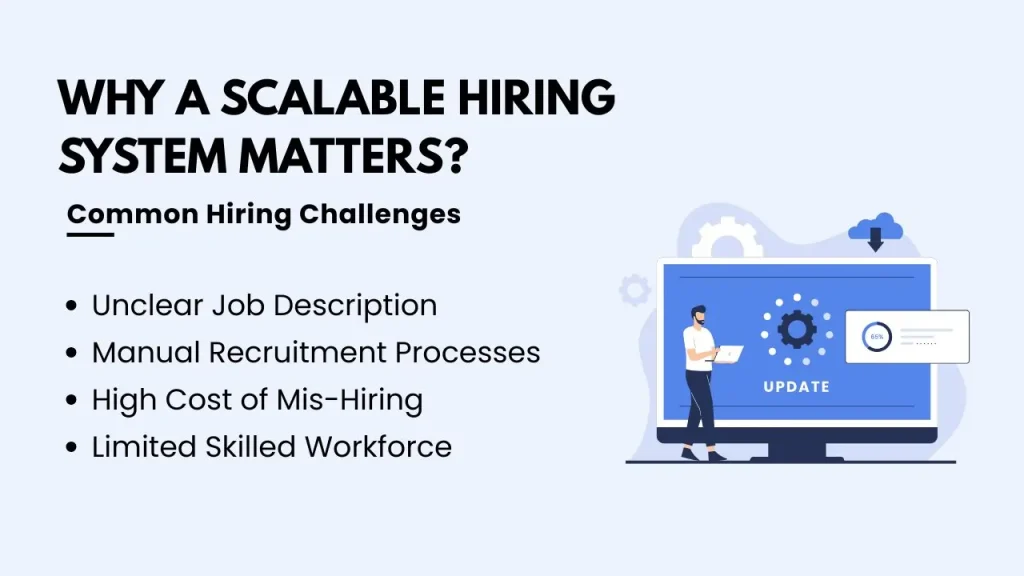
Common Hiring Challenges in Nepal
Nepali businesses face several challenges when hiring:
1. Unclear Job Descriptions:
Many Nepali companies use vague JDs, leading to:
- Irrelevant applications
- Misaligned expectations
- Low-quality hires
2. Manual Recruitment Processes:
Without ATS or automation, HR teams waste time manually:
- Screening CVs
- Scheduling interviews
- Sending follow-ups
3. Slow Response Times:
Good candidates get offers quickly. Slow companies lose talent.
4. High Cost of Mis-Hiring:
Mis-hiring leads to:
- 3–6 months of salary wasted
- Low productivity
- Team disruption
- Re-hiring costs
5. Limited Skilled Workforce
Shortage of skilled professionals in IT, engineering, marketing, hospitality, etc.
Example:
An IT company in Kathmandu cut hiring time by 50% after implementing an ATS and structured process.
For more insights, see:
👉 Recruitment Mistakes in Nepal: How Companies Can Improve Their Hiring Process
Key Elements of a Strong Hiring System
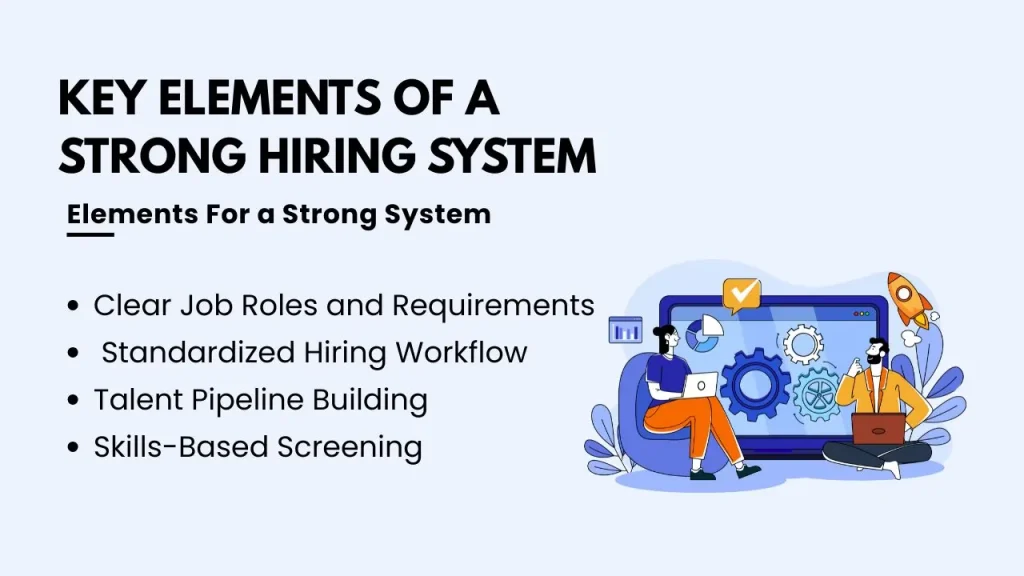
1. Clear Job Roles and Requirements
Job descriptions (JDs) are the foundation of a strong hiring system. Without clarity, recruitment fails.
Best practices for Nepali companies:
- Define responsibilities clearly
- Mention required tools, skills, experience
- Add KPIs and expected outcomes
- Avoid generic copy-paste templates
Example: A Pokhara-based startup reduced irrelevant applications by 40% using structured JD templates.
For best practices:
👉 Best Recruitment Practices for Nepalese Employers
2. Standardized Hiring Workflow
A scalable hiring system in Nepal must follow a repeatable workflow:
Example Workflow
- Requirement approval
- Job description creation
- Job posting
- Application screening
- HR interview
- Skills test
- Final interview
- Reference check
- Offer Letter
- Onboarding
Benefits of a standardized process:
- Faster hiring
- Consistent evaluation
- Better candidate experience
- Reduced bias
For a step-by-step process guide:
👉 8 Simple Steps to a Successful Recruitment Process in Nepal
3. Talent Pipeline Building
A talent pipeline ensures Nepali companies have pre-qualified candidates ready when positions open.
Tips for building talent pipelines:
- Keep lists of qualified candidates from previous openings
- Maintain relationships with passive candidates on LinkedIn
- Use internship programs as a pipeline
- Partner with recruitment agencies for high-demand roles
Case Study: A Nepali digital marketing agency maintained a talent pool of 50 candidates. They filled 3 open positions within a week instead of months.
For guidance on recruitment agencies and talent pools:
👉 Staffing Services in Nepal: How Recruitment & Outsourcing Help Businesses Hire the Right Talent
4. Skills-Based Screening
Relying solely on CVs leads to poor hiring outcomes. Nepali companies can improve by:
- Conducting skill assessments
- Assigning tasks or mini-projects
- Using structured interview scorecards
- Evaluating based on results, not impressions
Tip: Incorporate performance-based hiring to reduce bias and improve quality.
For technology-assisted hiring:
👉 How Technology Improves Recruitment in Nepal
Tools and Technology to Scale Hiring Process in Nepal
Modern tools make scalable hiring system in Nepal, efficient, and data-driven.
1. Applicant Tracking System (ATS)
ATS systems help manage applications and track candidate progress. Benefits include:
- Centralized candidate management
- Automated filtering and ranking
- Interview scheduling
- Reporting and analytics
Popular ATS in Nepal:
- Talent Connects ATS
- Nimble ATS
Global tools: BreezyHR, BambooHR
For software recommendations:
👉 Recruitment Tools and Software for Nepali Businesses (2026)
2. Automate Repetitive Tasks
Automation helps HR teams focus on high-value activities:
- Auto-responses to applicants
- Resume screening
- Scheduling interviews
- Sending follow-up reminders
Tip: Automation reduces response time and improves candidate experience.
3. Employer Branding Nepal
Strong employer branding attracts top talent:
- Create a professional careers page
- Share employee stories
- Highlight company culture
- Engage candidates on social media
For a full guide:
👉 Employer Branding in Nepal 2026: Attract & Retain Top Talent
Step-by-Step Guide to Building a Scalable Hiring System in Nepal
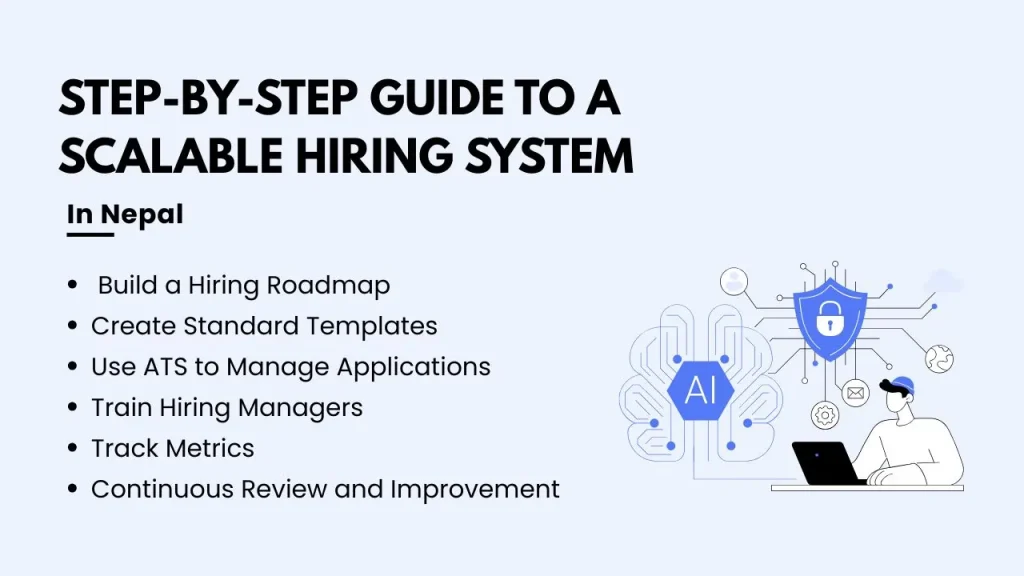
Step 1: Build a Hiring Roadmap
Forecast hiring based on:
- Growth plans
- Departmental needs
- Skills required for future projects
Tip: Align recruitment with business goals to avoid last-minute hiring.
Step 2: Create Standard Templates
Templates ensure consistency:
- Job descriptions
- Interview scorecards
- Evaluation sheets
- Offer letters
- Onboarding checklists
Step 3: Use ATS to Manage Applications
Centralized management improves efficiency:
- Track candidate progress
- Assign interviewers
- Maintain talent history for future hiring
Step 4: Train Hiring Managers
- Structured interview training
- Skills evaluation techniques
- Reducing bias
- Using scoring templates
Case Study: A startup in Lalitpur trained 5 hiring managers. They improved hiring quality by 35% within six months.
For details on talent pools and outsourcing:
👉 Benefits of Using a Staffing Agency in Nepal
Step 5: Track Metrics
Important metrics include:
- Time-to-hire
- Cost-per-hire
- Candidate drop-off rate
- Quality-of-hire
- Retention of new employees
Data-driven decisions improve recruitment continuously.
Step 6: Continuous Review and Improvement
- Evaluate and refine workflows every quarter
- Update JD templates and scorecards
- Introduce new tools or ATS features
- Monitor hiring KPIs
For insights:
👉 HR Technology and ATS in Nepal
Nepal-Specific Hiring Challenges and Solutions
| Challenge | Solution |
| Limited skilled workforce | Internal training, upskilling |
| Manual recruitment | Use ATS + automation |
| Unstructured interviews | Scorecards, structured questions |
| Slow response time | Automated follow-ups |
| High employee turnover | Better onboarding + engagement (How Nepali Companies Can Reduce Employee Turnover) |
Scalable Hiring for Startups vs Large Nepali Companies
A scalable hiring system in Nepal isn’t the same for every business. Startups, SMEs, and large companies face different hiring challenges, and the recruitment system for Nepali companies must match the stage of growth.
Startups and early-stage companies in Nepal usually hire for speed and versatility. One employee may handle multiple responsibilities, so cultural fit, learning ability, and adaptability also matter. For startups, a scalable hiring system in Nepal should focus on:
- Fast decision-making
- Skills-based screening instead of long CV reviews
- Lean hiring workflows with fewer approval layers
- Building a small but reliable talent pipeline early
Mid-sized and large Nepali companies need structure and consistency. As teams grow, unstructured hiring leads to misalignment, duplication of roles, and higher turnover. Larger organizations benefit from:
- Clearly defined job roles and reporting lines
- Multi-stage interviews with standardized evaluation
- ATS-driven recruitment workflows
- Strong onboarding and documentation
The key is scalability. Startups should build simple systems that can grow, while large companies must avoid overcomplicating hiring process in Nepal to the point where speed and candidate experience suffer.
Hiring Timeline and Expectations in Nepal
Understanding realistic hiring timelines is critical when building a scalable hiring system in Nepal. Many businesses underestimate how long hiring takes, leading to rushed decisions and missed talent.
Typical hiring timelines in Nepal:
- Entry-level or junior roles: 15–25 days
- Mid-level professionals: 25–40 days
- Senior or specialized roles: 40–60 days
Delays usually happen due to:
- Manual CV screening
- Unstructured interview scheduling
- Slow internal approvals
- Lack of clear hiring ownership
Companies with a structured recruitment process and ATS support can reduce time-to-hire by 30–50%. Faster hiring not only improves productivity but also prevents losing top candidates to competitors.
Tips for Nepali Companies to Improve Hiring
- Prioritize skills over degrees
- Use structured interviews for consistency
- Maintain a talent pool for faster recruitment
- Invest in HR technology and ATS
- Track KPIs like time-to-hire and quality-of-hire
- Partner with recruitment agencies for niche roles
- Continuously improve your hiring workflow
Case Studies
- IT Startup in Kathmandu: Reduced hiring time by 50% using ATS and structured interviews.
- Marketing Agency in Pokhara: Built a talent pipeline of 50 candidates; filled 3 positions in 1 week.
- Mid-sized Construction Company: Introduced structured onboarding and reduced first-year turnover by 30%.
External References
Partnering with a Professional Recruitment Agency
For many Nepali companies, building an internal hiring system does not mean handling everything alone. Partnering with a professional recruitment agency can significantly improve hiring outcomes, especially during rapid growth or high-volume hiring phases.
Recruitment agencies in Nepal support companies by:
- Accessing pre-vetted talent pools
- Screening candidates based on skills and role fit
- Reducing hiring workload for internal HR teams
- Filling niche or hard-to-hire positions faster
This approach is especially useful when:
- Internal HR teams are stretched
- Specialized skills are required
- Hiring needs to scale quickly
- Time-to-hire is affecting business growth
When combined with a structured internal process and ATS, recruitment system for Nepali companies become an extension of the hiring system rather than a replacement. The result is faster hiring, better candidate quality, and reduced mis-hiring risk.
Conclusion
A scalable hiring system in Nepal is essential for business growth.
By using structured hiring workflows, skill-based screening, talent pipelines, ATS tools, and continuous improvement, Nepali companies can:
- Hire faster
- Reduce mis-hiring
- Improve team performance
- Scale efficiently
For actionable tips and recruitment solutions, explore: TalentSathi Blog
FAQ
Why do Nepali companies need a structured hiring system?
To speed up recruitment and improve quality-of-hire.
What is a talent pipeline, and why is it important?
A talent pipeline is a pool of pre-qualified candidates ready for future roles, ensuring minimal delays in hiring.
Can small businesses in Nepal implement ATS?
Yes — tools like Talent Connects and Nimble ATS are affordable.
How do structured interviews help?
They reduce bias and create consistent evaluations.
How can Nepali companies reduce employee turnover?
Strengthen onboarding, clarify roles, and track performance.