The difficulty of hiring in Nepal is rarely an issue. The problem is to hire the right individual at the right cost at the least risk. In case of comparison between In-House HR vs Recruitment Agency in Nepal, the correct option can be made in three terms:
The hiring volume, the complexity of the role, and how much hiring delay you can afford.
This guide explains the real difference to HR managers, founders, and business owners. It also addresses the information job seekers need to know about direct versus agency applications.
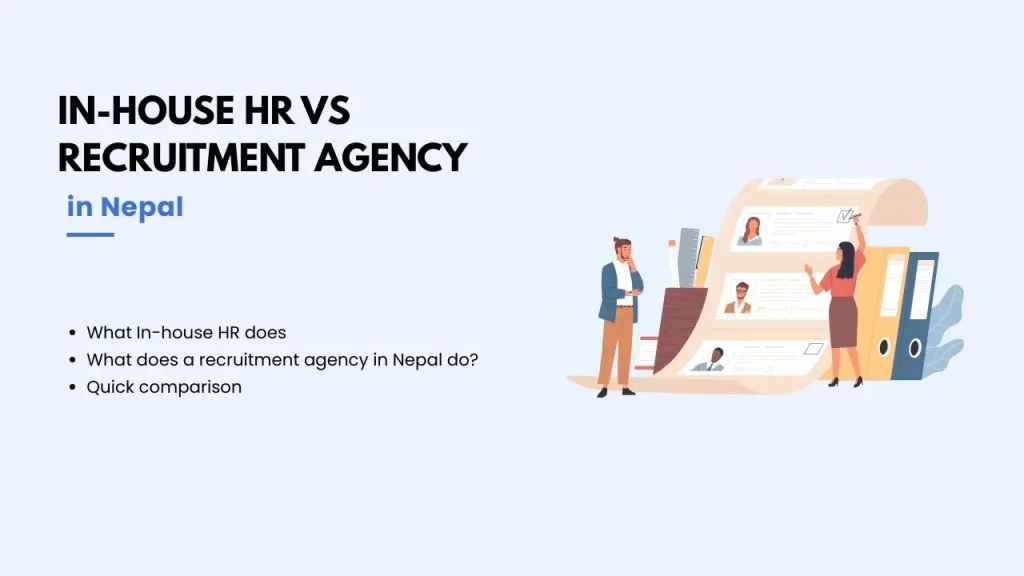
In-House HR vs Recruitment Agency
What in-house HR does
In-house HR is your internal team that manages the people function. Recruitment is only one part of their work.
Common in-house recruiting activities:
- Workforce planning and job approval
- Writing job descriptions and posting
- Sourcing and screening
- Interview coordination
- Joining and following up on offers.
- Onboarding handover
What does a recruitment agency in Nepal do?
A recruitment agency in Nepal is an outsourced employment firm that aims to base its results on hiring. Agencies usually run a defined pipeline and provide shortlisted candidates.
Common agency services:
- Role intake and hiring plan
- Sourcing from the network, database, referral, and outreach.
- Screening and shortlisting
- Interview coordination
- Negotiation support
- Replacement or guarantee terms, depending on the contract.
Quick comparison table
| Factor | In-House HR | Recruitment Agency (Nepal) |
| Cost | Fixed salary cost plus HR tools plus internal time cost | Placement fee or retainer; often performance-based |
| Time to hire | Depends on HR workload and internal sourcing strength | Usually faster due to dedicated sourcing and active pipelines |
| Expertise | Strong on internal process, culture fit, and company context | Strong on sourcing, screening, and market reach |
| Talent pool access | Mostly limited to your brand reach and channels | Wider access through databases, networks, referrals, and outreach |
| Screening quality | Varies by HR capacity and scorecards | Varies by agency; strong agencies send fewer but better matched |
| Scalability | Hard to scale quickly without hiring more recruiters | Easy to scale for multiple roles or urgent hiring |
| Flexibility | Tied to internal bandwidth and priorities | Flexible ramp up or down based on hiring demand |
| Control | Full control over process and candidate experience | Shared control; depends on SLA, reporting, and alignment |
| Speed for niche roles | Slower if you lack networks for niche talent | Faster if the agency specializes in that role type |
| Risk | Risk of delays and HR overload; knowledge stays internal | Risk of dependency and inconsistent quality across agencies |
| Best fit | Stable hiring needs, long-term capability building | Volume hiring, niche roles, urgent hiring, and limited internal bandwidth |
Is It Better to Apply Directly or Through an Agency?
Applying directly
How it usually works:
- You send applications through the company page, job portals, referrals, or email.
- You wait to get screening and interview calls.
- You negotiate directly with the employer.
Best when:
- You want maximum control and direct communication.
- The employer is responsive and has a clear hiring process.
- There is a very strong referral at the company.
Limitations:
- Your request may get stuck in high-volume mailboxes.
- You may not get feedback
- You may compete with a large pile of unfiltered applicants.
Applying through a recruitment agency in Nepal
How it usually works:
- You provide the agency with your profile.
- They filter you out and send you to similar positions.
- They organize interviews and follow-ups.
Best when:
- You desire to get access to non-posted roles.
- You would like to be told about your resume, remuneration, and interview preparation.
- You desire accelerated scheduling and follow-ups.
Limitations:
- You are reliant on the client list of the agency.
- Some agencies force out the positions that do not fit.
- Not all agencies are transparent, so choose carefully.
Job seeker rule:
In case an agency requests money to find you a job locally, treat it as a red flag and verify the terms properly. To develop formal guidelines on fair hiring, refer to the ILO guidelines.
Pros and Cons of Using a Recruitment Agency in Nepal
Pros
Time efficiency
Agencies decrease the time on sourcing and filtering; therefore, fewer candidates are interviewed by your team.
Access to a wider talent pool
Good agencies have pipelines that are active and access passive candidates faster.
Market intelligence
They can guide salary ranges, notice periods, and availability trends.
Recruitment outside of sourcing.
Numerous agencies assist in scheduling, negotiation, and joining assurance.
Cons
Fees
When you just compare it to the job posting cost, the agency fees may be costly. The real comparison is the cost of delay and the cost of wrong hire.
Dependency risk
If you outsource everything and never build internal capability, you become dependent.
Quality varies
Some agencies send volume. Others send fit. The choice of your screening criteria and reporting structure is important.
HR vs Recruitment Service Difference
Recruitment is a function. HR is a system.
Human resources management covers
- Policies and compliance
- Compensation and benefits
- Performance management
- Culture and employee relations.
- Learning and development
- Retention and exits
Recruitment focuses on
- Sourcing candidates
- Screening and shortlisting
- Interview coordination
- Offer and joining pipeline
The significance of the difference:
When your HR department is overwhelmed with operations, it decreases the quality of recruitment. When recruitment is regarded as an independent engine, the process of hiring becomes predictable.
To have much better standards in recruitment processes, ISO offers a template of recruitment guidelines that you could consider and organize your hiring process.
Cost breakdown in Nepal: Internal HR vs recruitment agency
Internal HR costs are mostly fixed. Agency expenses tend to fluctuating and be dependent on every hire.
Internal HR cost
- Hiring tools, fixed salary and benefits, and overheads of the administration.
- Variable per hire job advert, recruiter time, interview time by hiring manager, and assessment.
- Unseen expenses: vacancy delay, wrong hire, and time onboarding.
Recruitment agency cost
- Prices: success fee, retainer, hybrid.
- Generally includes sourcing, screening, shortlisting, interview coordination, offer support, and follow-up.
- Authenticate advance replacement conditions, shortlist turnaround time, scope, and background check.
Fair comparison
- Internal cost per hire: recruiter time + manager time + tool cost share, + vacancy cost.
- Agency cost per hire: agency fee + internal interview time + vacancy cost.
Recommendation for Businesses in Nepal
When in-house HR is better
Choose internal hiring when:
- You hire consistently but not urgently.
- Your employer brand pulls candidates naturally.
- You need tight control over culture fit.
- You already have effective sourcing channels and screening systems.
Practical triggers:
- You are recruiting 1 to 3 positions monthly.
- Roles are common and easier to evaluate.
- Your HR has space and definite KPIs.
When is a recruitment agency in Nepal better
Using a recruitment partner is necessary when:
- Speed is essential, and you can not spare vacancy downtime.
- You are recruiting for various positions simultaneously.
- Roles are niche, senior, or technical.
- You are weak in sourcing internally.
Practical triggers:
- You require shortlists within days rather than weeks.
- You are scaling a team fast
- Your human resources department is overworked.
A hybrid approach that usually works best
The split is usually the most successful among growing companies in Nepal:
In-house HR owns:
- Hiring plan and scorecards
- Final interviews and culture assessment.
- Approval of offer and internal alignment.
Agency owns:
- Sourcing and initial screening.
- Evidence-based shortlisting with notes.
- Scheduling interview assistance.
The hybrid model secures control and increases speed.
For startups and SMEs in Nepal: what usually works
You are attempting to hire as you are building the business. This is the reason why the choice of hiring decisions must be based on speed, cash flow, and risk control rather than ideal HR org charts.
Startups
The most appropriate one typically is agency or hybrid when you are recruiting your first team, or scaling fast, or when recruiting positions that have a direct impact on revenue and delivery.
- Retain role clarity, interview scorecards, as well as final decisions.
- Outsource sourcing and first-level screening in order to save time on unqualified candidates.
Here is a detailed guide on recruiting challenges and solutions for startups:
Top recruiting challenges in Nepal startups.
SMEs
SMEs have a consistent hiring process but do not need to support a full recruitment engine.
The most cost-efficient way is typically the lean internal HR and recruitment on demand.
Recruitment services should be used when a company has several vacant positions, when it is urgently required to fill an empty position, or in cases where the company desires to minimize the number of drop-offs and no-shows.
Here is a comprehensive guide on the benefits of recruitment services for SME to understand what would be better for your business.
Recruitment Service for SMEs in Nepal.
Conclusion
There is no debate between in-house and agency recruiting and which is the best. It is a choice of where you will utilize your limited time.
To have control and long-term capability, develop internally. But if you require rapidity, coverage in the market, and a rapid shortlist, then an agency is what you require.
In case you need both, use a hybrid model and measure quality in terms of time to hire, interview-to-offer ratio, and retention upon joining.
FAQ
Difference between agency and in-house recruitment?
Agency delivers hires. In-house builds and runs your full hiring system.
Is it a good idea to use a recruitment agency?
Yes, if you need speed or lack internal bandwidth.
Do recruitment agencies charge job seekers in Nepal?
Normally no. Employers pay. If you are asked to pay, treat it as a red flag.
What is the best recruitment method?
Hybrid is best for most companies: internal for control, agency for sourcing speed.
How to choose a good recruitment agency in Nepal?
Check screening quality, turnaround time, replacement terms, and reporting. Pilot with one role.