
IT companies rarely grow in a straight line. Some months are calm, while others are filled with tight deadlines, new client demands, and urgent delivery pressure. In such situations, hiring full-time employees for every project requirement often creates more problems than solutions.
This is where project-based hiring for IT companies becomes useful.
Instead of making long-term hiring decisions for short-term needs, project-based hiring allows IT companies to bring in skilled professionals for a specific project, time period, or technical requirement. It helps companies stay flexible, control costs, and deliver work on time without overloading their core teams.
At TalentSathi, we work closely with growing IT companies in Nepal to solve hiring challenges through flexible models like project-based hiring. We understand the pressure of tight deadlines, changing technologies, and limited budgets, and help companies build the right teams without long-term hiring risk.
What Is Project-Based Hiring in IT?

Project-based hiring in IT involves recruiting external talent such as contractors, freelancers, or staff augmentation specialists to work on clearly defined tasks or deliverables within a project lifecycle. Unlike permanent hiring, these engagements are temporary and focused on outcomes, scope, and timelines.
These hires are not permanent employees. They are engaged to:
- Time-bound engagements
- Defined deliverables
- Flexible team composition
- Access to niche expertise
- Cost effectiveness
Once the project is completed, the engagement ends.
This hiring model focuses on skills and outcomes, not long-term headcount. For IT companies that work on client projects, product releases, or technology upgrades, this approach is often more practical than traditional hiring.
Many SMEs in Nepal find working with a recruitment service for SMEs in Nepal simplifies project-based hiring and ensures they get the right skills quickly.
Why Traditional Hiring Often Fails IT Companies

Many IT companies hire full-time employees when:
- A new project starts
- A client demands faster delivery
- A new technology is introduced
But when the project ends, companies are left with:
- High fixed salary costs
- Underutilized resources
- Difficult workforce decisions
Project-based hiring solves this mismatch by aligning hiring directly with real work requirements.
IT companies often debate between in-house HR vs recruitment agency in Nepal. For project-based hiring, agencies are usually faster and more flexible.
Top 5 Benefits of Project-Based Hiring for IT Companies
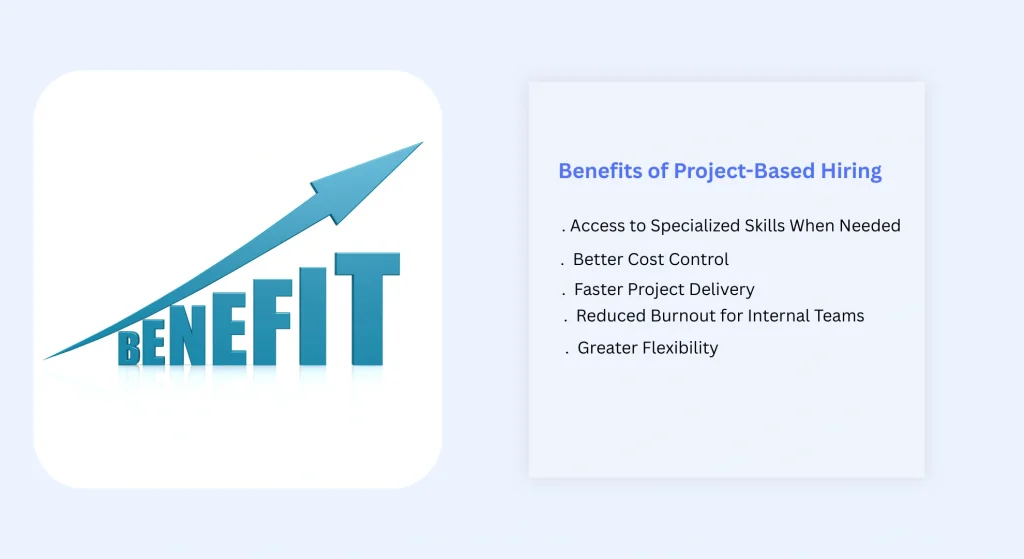
Access to Specialized Skills When Needed
With project-based hiring in IT, companies can bring in specialists only when needed. You can hire experts in AI, cloud infrastructure, or cybersecurity for short-term projects without adding permanent staff.
With IT project-based hiring, companies can bring in specialists only when their expertise is required. This allows access to high-level skills without the cost of permanent roles.
Cost Efficiency
With contract hiring for IT companies, businesses pay for work delivered, not for idle time.
- Long-term salary commitments
- Employee benefits and overhead costs
- Financial risk during slow periods
For startups and SMEs, this makes hiring more sustainable.
Many companies use staffing services in Nepal to source temporary talent for IT projects quickly and effectively.
Faster Project Delivery
Project-based professionals are usually experienced and focused on delivery. They require less training and adapt quickly to project needs.
- Faster execution
- Shorter learning curves
- Better adherence to deadlines
Reduced Burnout for Internal Teams
When internal teams handle every task, pressure builds quickly. Temporary IT hiring helps distribute workload during busy phases, allowing full-time employees to focus on long-term goals without exhaustion.
Greater Flexibility
IT staffing for projects allows companies to scale teams up or down based on workload. This flexibility is critical for companies operating in competitive and fast-changing markets.
Types of Project-Based Jobs in IT
Project-based jobs exist across almost all IT roles.
Software Developers
- Frontend, backend, and full-stack development
- Feature development
- System upgrades
QA and Testing Engineers
- Manual and automation testing
- Performance testing
- Security testing
UI/UX Designers
- Product redesign
- App interface improvements
- User experience optimization
DevOps and Cloud Engineers
- Cloud migration
- Infrastructure setup
- CI/CD automation
Data and AI Specialists
- Data migration
- Analytics dashboards
- AI model implementation
Real Examples of IT Projects Using Project-Based Hiring
Project-based hiring works best for clearly defined projects, such as:
- Mobile app development
- ERP or CRM implementation
- E-commerce platform setup
- Cloud migration projects
- Cybersecurity audits
- API development and system integration
When Should IT Companies Use Project-Based Hiring?
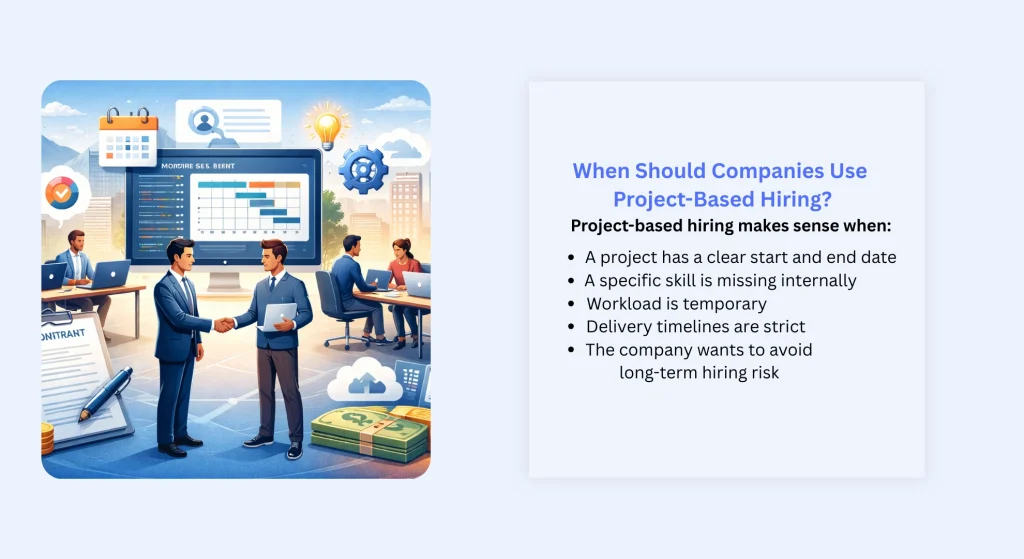
- A project has a clear start and end date
- A specific skill is missing internally
- Workload is temporary
- Delivery timelines are strict
- The company wants to avoid long-term hiring risk
Many of these situations are reflected in our real-world hiring case studies, where IT companies used project-based hiring to meet deadlines while controlling costs.
How Project-Based Hiring Works

Step 1: Define Project Requirements
Before hiring, clearly outline:
- Project goals
- Required skills
- Duration
- Budget
Step 2: Source the Right Talent
Use recruitment agencies, staffing partners, or contract hiring platforms. Experienced recruiters help screen candidates faster and more accurately.
Step 3: Onboard and Integrate
Even temporary hires need onboarding. Provide tools, documentation, and communication channels to ensure smooth collaboration.
Step 4: Complete and Close the Project
Once the project is delivered:
- Review performance
- Ensure documentation
- Close the engagement professionally
Here’s a simple framework IT companies can follow to implement project-based hiring effectively:
Using recruitment tools and software for Nepali businesses can help identify skilled talent faster and more accurately.
Key Challenges and How to Manage Them
- Knowledge Retention: Temporary staff may leave with critical project knowledge.
- Solution: Implement thorough documentation, handovers, and consider rehiring trusted professionals for recurring projects.
- Team Integration: Rotating team members can impact culture and collaboration.
- Solution: Treat project-based hires as team extensions, not replacements, and ensure smooth onboarding and communication.
- Operational Alignment: Temporary talent may need guidance to adapt to internal systems and workflows.
- Solution: Define roles clearly and establish structured onboarding/offboarding processes.
- Talent Sourcing: High-demand specialists can be difficult to find quickly.
- Solution: Partner with specialized staffing agencies or online platforms to secure skilled professionals efficiently.
Is Project-Based Hiring Right for Your IT Company?
Project-based hiring is an excellent solution for IT companies that need agility, access to specialized skills, and cost-effective staffing. Instead of committing to permanent hires for short-term needs, this approach allows organizations to bring in expert professionals for defined projects or critical tasks, ensuring timely delivery without overburdening internal teams.
While highly effective, it requires thoughtful management to avoid gaps in knowledge, maintain team harmony, and integrate temporary talent smoothly with permanent staff.
When Project-Based Hiring Works Best
- Handling Peaks and Deadlines: Scale up your workforce during high-demand periods, product launches, or urgent client projects without bloating permanent headcount.
- Accessing Specialized Expertise: Quickly engage professionals with niche skills, like AI, cybersecurity, cloud infrastructure, or advanced programming, for specific projects.
- Controlling Costs: Pay only for the work delivered rather than incurring long-term salaries and benefits, which is ideal for startups and SMEs.
- Accelerating Delivery: Temporary hires bring experience and focus, allowing projects to start immediately and finish faster.
- Injecting Innovation: External professionals often contribute fresh ideas and new perspectives, boosting creativity and problem-solving.
Should Your IT Company Adopt This Approach?
If your IT business faces variable workloads, short-term skill gaps, or tight project deadlines, project-based hiring can provide strategic flexibility, reduce overhead, and ensure faster delivery.
Most successful IT companies combine temporary experts with their permanent teams, creating a hybrid model that balances agility with retention of core knowledge and team cohesion, making it ideal for sustained growth and innovation.
Final Thoughts
Project-based hiring helps IT companies build teams around actual work, not assumptions. It allows businesses to stay agile, manage costs, and deliver quality results without long-term risk.
For growing software and IT companies, project-based hiring for IT companies is not just an option, it is a practical way to hire smarter.
FAQ
What is project-based hiring for IT companies near Lalitpur or Kathmandu?
Hiring professionals temporarily for a specific IT project in Lalitpur or Kathmandu.
What does “Project Hire” mean?
Hiring someone for a specific project instead of a permanent role.
How do I find project-based IT vacancies in Nepal?
Use recruitment agencies, staffing partners, or online job platforms like TalentSathi.
How to find international jobs for Nepalese?
Check recruitment agencies, job portals, and international hiring platforms.