Introduction: HR Data and Analytics in Nepal: Complete Guide for 2025
HR in Nepal is changing rapidly. Traditional HR methods based on files, spreadsheets, and intuition are becoming outdated. As businesses expand and struggle to attract and retain skilled employees, companies are now shifting toward data-driven HR Nepal, using HR analytics and people analytics to make faster and smarter decisions.
Instead of guessing why employees leave, which applicants perform better, or which team is struggling, HR data and analytics help Nepali companies get clear, evidence-based answers.
What Is HR Data and Analytics?
HR data and analytics refer to collecting HR information and using it to understand workforce behaviour, performance, hiring trends, turnover reasons, and organizational efficiency.
There are a few related terms that are helpful to understand:
| Type | Focus |
| HR Analytics | Recruitment, leaves, performance, training |
| People Analytics | Behaviour, engagement, culture, collaboration |
| Workforce Analytics | Headcount, cost, productivity, planning |
These terms overlap in practice. The label is not important, but the manner in which the company utilizes the data.
Types of HR Data Used by Nepali Companies
- Recruitment data: size of applicants, applications, interview scores, and acceptance of offers.
- Performance and appraisal data: ratings, feedback documents, performance attained, promotions.
- Attendance and leave: absenteeism patterns, overtime, late arrivals, leave balances.
- Engagement and feedback: survey responses, pulse checks, suggestion forms.
- Learning and development: training hours, course completion, skill assessment scores.
- Compensation and benefits: pay scales, increment, bonus plan, utilization of benefits
Companies on various levels can study this data:
- Descriptive analytics – What happened?
Example: “We had 25 resignations last quarter.” - Diagnostic analytics – Why did it happen?
Example: “Turnover is highest in teams with low manager ratings.” - Predictive analytics – What might happen next?
Example: “These employees are at high risk of leaving in the next six months.”
Why HR Data and Analytics Matter for Companies in Nepal
Many Nepali companies still rely on manual HR, basic spreadsheets, and traditional processes. But today:
- Employees expect transparency, learning, growth, and fairness
- Businesses need faster decisions
- Manual HR is slow, inconsistent, and prone to bias
- HR managers need stronger HR reporting Nepal
HR data and analytics can correct such a situation by transforming raw HR data into valuable insights. Instead of just storing attendance or performance records, companies can analyze patterns:
- What are the most difficult positions to recruit?
- What are the departments with the most turnover?
- Which training will result in improved performance?
- Which managers have the most engaged teams?
Data-driven HR is becoming the new standard. It uses clear metrics to guide hiring, promotions, pay, and performance.
HR Analytics vs People Analytics vs Workforce Analytics in Nepal
| Feature | HR Analytics | People Analytics | Workforce Analytics |
| Focus | HR processes | Engagement, behaviour | Cost, planning |
| Best For | Hiring, leaves, performance | Culture, collaboration | Headcount and cost optimization |
| Output | HR KPIs | Team insights | Workforce forecasting |
Benefits of HR Analytics for Nepali Companies
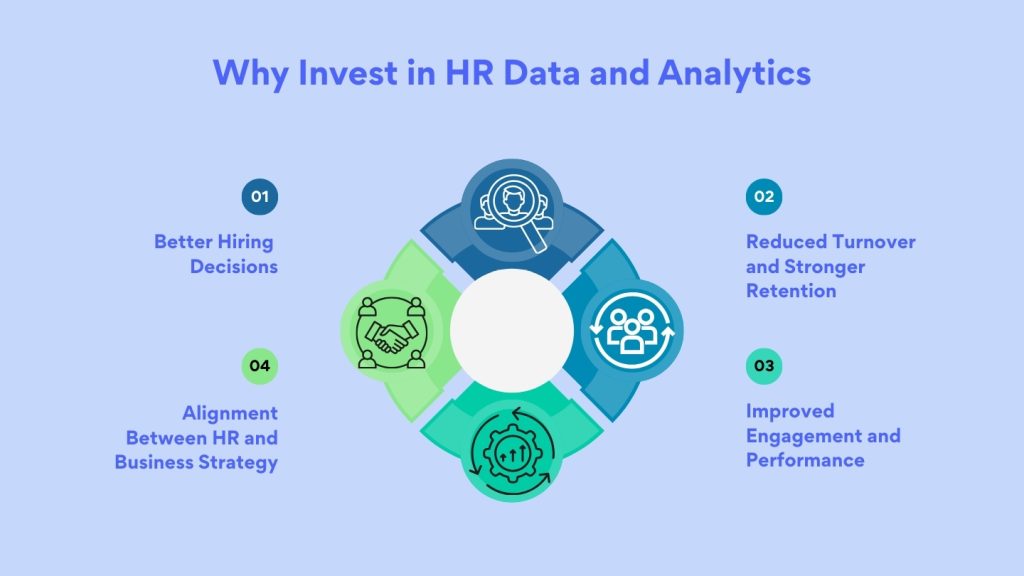
HR data and analytics, as well as people analytics, are not simply a trend to invest in. It has practical advantages that have direct business outcomes.
Better Hiring Decisions
- Recruitment is expensive; a poor recruitment damages productivity and clients.
- HR data and analytics indicate the channels that provide better candidates.
- Firms are able to monitor time to hire and post-joining performances.
- Result: smarter and more focused hiring.
Lower Turnover and Higher Retention
- High turnover is a big problem in Nepal.
- Analytics displays the reasons to leave (team, manager, pay, growth).
- HR can target solutions such as career paths, training, pay reviews, and workload balance.
- Result: improved employee retention.
Improved Engagement and Productivity
- Involved employees are more productive and stay longer.
- People analytics links engagement scores with performance and absenteeism.
- Leaders observe the effect of culture and communication.
- Result: stronger, more productive teams.
Alignment Between HR and Business Strategy
- HR data transforms emotions into definite numbers and tendencies.
- Leaders receive responses about turnover cost, skills shortage, and the risk of burnout.
- People analytics bridges the gap between HR metrics and revenue and productivity
- Result: HR acts as a strategic business partner, not just admin.
HR Data and Analytics in the Context of Nepali Organizations
Most organizations in Nepal are either using paper, simple spreadsheets, or some use HR systems without full analytics. Only a few are investing in people analytics and HR data to have better insight.
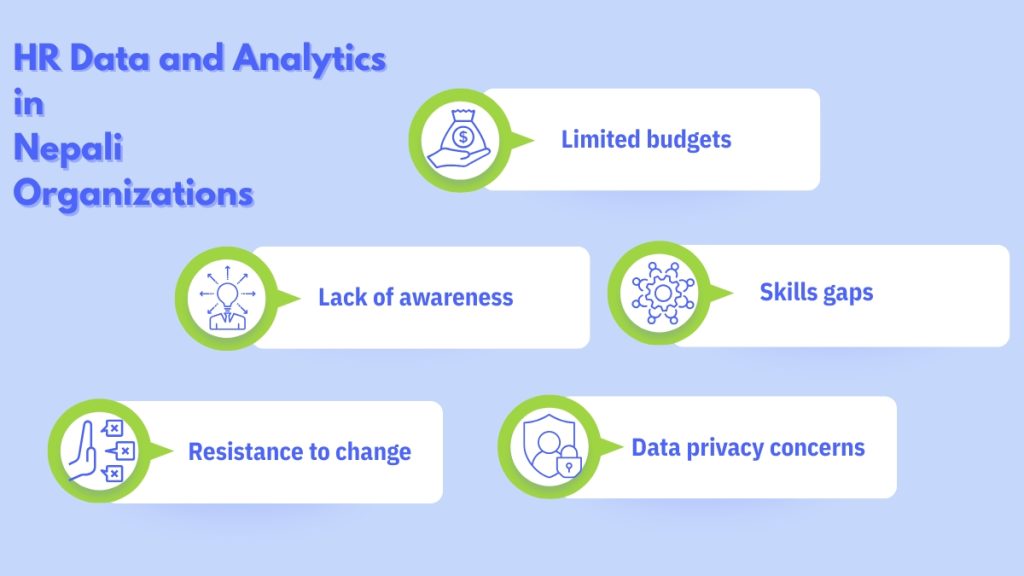
Common challenges include:
- Limited budgets for HR technology and tools.
- Lack of awareness about what HR data and analytics are.
- Skills gaps, where the HR teams lack skills related to data and analysis, but are strong in people skills.
- Resistance to change, particularly when the employees and the leaders are used to the previous method of operation.
- Data privacy concerns, as companies begin to store more personal data about employees digitally.
At the same time, there is a clear opportunity.
- Companies adopting HR data and analytics in Nepal can stand out in the market.
- They can hire more ambitious employees, provide them with more career opportunities.
- Early adopters of people analytics can make faster, fairer decisions.
Practical HR Analytics Use Cases for Nepali Businesses
Real use cases are one of the most effective methods of understanding HR data and analytics, and people analytics. Here are some common scenarios that Nepali businesses can start with.
Recruitment Analytics
Instead of just posting jobs everywhere and hoping for the best, companies can track where their best candidates come from. They can measure:
- Number of applicants per channel (job portal, social media, referrals, campus).
- Time taken to fill each role.
- Offer acceptance rates.
- Performance and retention of hires from each source.
Turnover and Retention Models
- Examine exit data and employee profiles to locate trends as a cause of resignations.
- Determine the risk factors such as excessive workload, low involvement, or lack of training.
- Apply people analytics to define the most likely to leave groups.
- Design-focused activities: mentoring, flexible working, and key role retention.
Performance and Learning Analytics
- Training does not yield the same outcome.
- HR data and analytics correlate the hours and types of courses with the performance and results.
- Determine which of the programs actually enhances skills
- Make L&D budgets more strategic and support real employee growth.
Engagement and Well-being Dashboards
- People analytics monitors the trends of morale, stress, and well-being.
- Integrate field survey data with data on overtime, absenteeism, and leave.
- Identify the symptoms of early burnout in teams/departments
- Allow leaders to make early interventions and assistance before performance declines.
Predictive analytics for hiring
- Growing companies can go beyond basic reports to predictive analytics for hiring.
- Use past data to see which candidate profiles are more likely to succeed.
- Identify roles that will be harder to fill in the future.
- Estimate how long future hiring might take.
For a broader view of hiring and HR practices, you can also read our article on best recruitment practices for Nepalese employers
Step-by-Step HR Analytics Journey
One does not have to start the journey with HR data and analytics or people analytics with perfection. It requires clarity and consistency.
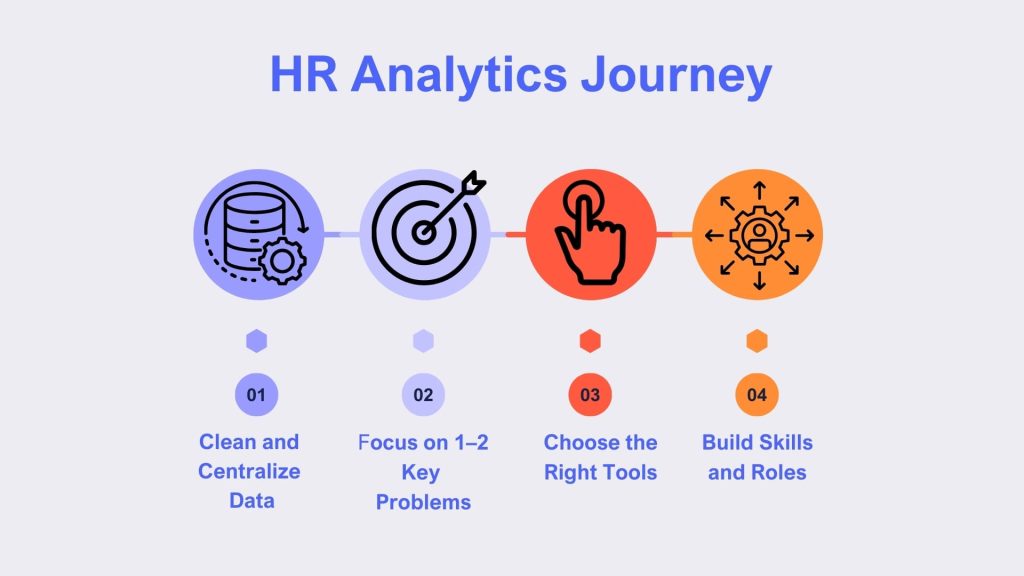
A simple roadmap:
Step 1: Clean and Centralize Data
- Gather HR information on attendance, payroll, performance, and recruitment.
- Eliminate mistakes and duplication.
- Keep all the data in a systemized, regular manner (preferably in a single HR system).
Step 2: Focus on 1–2 Key Problems
- Don’t analyze everything at once.
- Select the top issues, such as high turnover, delayed hiring, or lack of engagement.
- Define clear questions you want the data to answer.
Step 3: Choose the Right Tools
- Choose the tools that fit your size and budget.
- Options: HR management system, cloud HR platform, or structured spreadsheets.
- Ensure that tools boost your priorities, rather than lead them.
Step 4: Build Skills and Roles
- Provide essential data and analysis training to HR personnel.
- Step by step, recruit individuals who have an interest or experience in HR analytics.
- A small internal HR data and analytics ability can produce a huge difference.
Step by step, recruit individuals who have an interest or experience in HR analytics. If you are considering this route, you can go ahead and explore our guide on Why Choose a Recruitment Company in Nepal for Your Business in 2026?
Building HR Analytics Capability in Nepal
Tools are significant, yet human beings make the difference. To become effective, HR data and analytics, and people analytics require the appropriate skills and culture at companies.
Key skill areas include:
- Knowledge of HR context and processes.
- Basic statistics and comfort with numbers.
- Skills in using Excel or business intelligence.
- Communication and storytelling skills to serve up findings.
Leadership plays a big role. When leaders embrace information-based decision-making, the projects of HR analytics have higher chances of success. Even good tools will not be useful in the event that they disregard the information or are resistant to change.
Common Mistakes Nepali Companies Make in HR Data and Analytics
Mistakes are common with many companies when they initially invest in HR data and analytics and people analytics. These errors would help save a lot of time and money.
Common pitfalls include:
- Purchasing costly tools that lack clearly defined uses or internal expertise which leads to under-utilization of software.
- Regarding analytics as a single project instead of a continuous method of operation.
- Disregarding the issue of data quality and attempting to construct analytics using inconsistent or incomplete data.
- Showing HR numbers only without connecting them to the business performance, which causes leaders to become interested.
Conclusion
Investing in HR data and analytics, as well as people analytics, is not just about technology. It is about building a smarter, fairer, and more effective way of managing people. The effects of this investment on companies in Nepal include the ability to hire better talent, retain top performers, engage employees more effectively, and align HR and business strategy more closely.
The journey can start small: clean data, simple reports, and a few focused questions. For companies that also need external support with hiring and workforce planning, Staffing services in Nepal can work alongside HR data and analytics to build a stronger, more agile talent strategy.
FAQs
Is HR analytics only for big companies?
No. Even small businesses can use HR data by cleaning records, tracking key metrics, and making smarter decisions.
Can HR analytics really show ROI for Nepali companies?
Yes. Tracking turnover, hiring costs, and productivity shows HR analytics’ financial impact.
What roles do we need to build HR analytics capability?
Roles like HR analysts, HRIS specialists, data-savvy HR managers, and HR business analysts.
Can HR analytics replace HR managers?
No. HR analytics supports HR, but human judgment, empathy, and context are still essential.
Why do some HR analytics projects fail or get stuck?
They often fail due to unclear goals, poor data, lack of ownership, or disengaged leaders.